McDermott and McClymond have done a great service for scholars and laypeople interested in Edwards by writing forty-five chapters in which they have provided syntheses of various aspects to Edwards's life, thought, and legacy. In essence, they have done all the grunt work that it would take to research the major themes on Edwards, supplying footnotes that identify the best secondary sources on specific topics. I also appreciate how McDermott and McClymond have written these chapters in clear prose, making the book accessible to Edwards scholars as well as non-specialists. Since many of the chapters are around ten pages or so, it is easy to read a little bit at a time without feeling that you have to commit to large blocks of time to finish a particular topic. On a per-page basis, the book is a bargain at around $50 in hardback for a text that is close to 800 pages in length.
Showing posts with label Gerald McDermott. Show all posts
Showing posts with label Gerald McDermott. Show all posts
Wednesday, 15 May 2013
Finished Lecture Notes on Jonathan Edwards Course
Today, I finished the lecture notes for my upcoming fall 2013 course, "Jonathan Edwards's Life, Thought, and Legacy in American Religious Culture." As mentioned before, the three required texts for the course are Jonathan Edwards: A Life, A Jonathan Edwards Reader, and Jonathan Edwards, Religious Tradition, and American Culture.
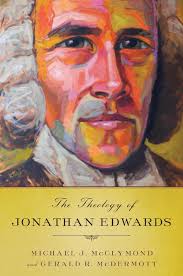 I hope to supplement the material in these three books with lectures that I have put together from reading such books as Ava Chamberlain's The Notorious Elizabeth Tuttle: Marriage, Murder, and Madness in the Family of Jonathan Edwards, Patricia Tracy's Jonathan Edwards, Pastor: Religion and Society in Eighteenth-Century Northampton, The Princeton Companion to Jonathan Edwards, The Cambridge Companion to Jonathan Edwards, and several specialized journal articles on Edwards. The book that I have found the most helpful on Edwards's thought is Gerald McDermott's and Michael McClymond's newly-published The Theology of Jonathan Edwards.
McDermott and McClymond have done a great service for scholars and laypeople interested in Edwards by writing forty-five chapters in which they have provided syntheses of various aspects to Edwards's life, thought, and legacy. In essence, they have done all the grunt work that it would take to research the major themes on Edwards, supplying footnotes that identify the best secondary sources on specific topics. I also appreciate how McDermott and McClymond have written these chapters in clear prose, making the book accessible to Edwards scholars as well as non-specialists. Since many of the chapters are around ten pages or so, it is easy to read a little bit at a time without feeling that you have to commit to large blocks of time to finish a particular topic. On a per-page basis, the book is a bargain at around $50 in hardback for a text that is close to 800 pages in length.
McDermott and McClymond have done a great service for scholars and laypeople interested in Edwards by writing forty-five chapters in which they have provided syntheses of various aspects to Edwards's life, thought, and legacy. In essence, they have done all the grunt work that it would take to research the major themes on Edwards, supplying footnotes that identify the best secondary sources on specific topics. I also appreciate how McDermott and McClymond have written these chapters in clear prose, making the book accessible to Edwards scholars as well as non-specialists. Since many of the chapters are around ten pages or so, it is easy to read a little bit at a time without feeling that you have to commit to large blocks of time to finish a particular topic. On a per-page basis, the book is a bargain at around $50 in hardback for a text that is close to 800 pages in length.


Wednesday, 27 February 2013
Gerald McDermott Rebuffs Alvin Plantinga

McDermott quotes Plantinga in the article as saying that Jonathan Edwards argued that God is the "only real cause of whatever happens," which implies that God is the real cause of all sin. McDermott goes on to explain that although Edwards believed that God upholds the whole of the created order in every moment (or, as McDermott says, in "every nanosecond"), this does not mean that humans are not held responsible for sin. Rather, because of our "natural necessity" and "moral necessity" (key terms in Edwards's Freedom of the Will) we have only ourselves to blame when we sin, even if God is in complete control of all that happens in the world. McDermott closes his letter by stating, "So is God, for Edwards, the 'only agent'--and therefore the only real cause--of the Holocaust, as Plantinga alleges? No and no."
If anything, McDermott's letter to the editor should be taken as a warning to even the brightest scholars who want to talk about Jonathan Edwards. With so many Edwards aficionados out there--and in a broad range of disciplines including history, biblical studies, theology, and sociology--one should be very careful in trying to articulate (particularly) Edwards's thought. Plantinga may still believe that he properly interpreted Edwards, but it would be difficult to remain firm on that conclusion when the coauthor of an 800-page tome entitled The Theology of Jonathan Edwards thinks that you have misunderstood "America's theologian."
Friday, 17 February 2012
Lights, Camera, Action!

Last evening closed out our "Religion in Early America: From the Great Awakening to the Revolution," series in the LeRoy Martin Distinguished Lecturer Series at UTC. All the lectures were videoed and will be available for sale on DVD. It was an amazing three nights!
As the organizer for this lecture series, I ate like a king all week at some of the best restaurants in Chattanooga. The only downside was the lack of sleep. I probably averaged about 4-5 hours of sleep this week because I handled nearly all the arrangements for this event, including shuttle runs to and from the airport, breakfasts, lunches, and dinners with the speakers and members of the Chattanooga community, as well as faculty at UTC and surrounding schools, technology setup at the lectures, advertising on the radio and in the newspaper, and catering services. I make no complaints though. It was a thrill to meet with some of the best scholars of religious history and thought in America, and offer their knowledge to the local public.
On Tuesday, February 14, Gerald McDermott spoke on "Jonathan Edwards, the Great Awakening, and the Future of Global Christianity." This is an abstract of his talk:
"Jonathan Edwards (1703-58) was a leader and analyst of the revival that helped shape early America. His experience with the Great Awakening led to an analysis of religious experience that has provided spiritual direction ever since. This lecture explains his relationship to the Awakening, outline his theology of discernment that emerged from the Awakening, and discuss his relationship to millennialism and American exceptionalism. Then it will propose that his larger theological vision is well-suited to the new shape of global Christianity, for it provides bridges between Catholics and Protestants, East and West, charismatics and non-charasmatics, and liberals and conservatives."
McDermott did not deliver his usual seamless, polished speech. Instead, he chose to take a more conversational tone when explaining the person and theology of Edwards. My sense is that the audience, made up of a collection of faculty, students, and people in the Chattanooga community, appreciated the fact that McDermott made Edwards approachable as an important figure in American religious history.
Scholars like McDermott, Marsden, and others have taken great pains to show Edwards as embodying more than simply a fire and brimstone preacher, and this message is making headway. Several people in the audience commented on how their perception of Edwards has now changed. They no longer viewed "America's Theologian" as simply the author of "Sinners in the Hands of an Angry God." As McDermott successfully demonstrated, Edwards was a complex thinker whose contribution to American history, and religion in general, is much broader in scope than most people realize. While I am not necessarily convinced that Edwards bridges the gaps between the East and West, Catholics and Protestants, and charasmatics and non-charasmatics in the way that McDermott proposed, I appreciated the passion that Roanoke's Jordan-Trexler Professor of Religion has for one of the most important thinkers America has produced.
Tommy Kidd's lecture on Wednesday, February 15, "Patrick Henry, the Great Awakening, and the Rise of Religious Liberty in Revolutionary Virginia," was (understandably) much more historical than the one by McDermott.
This is his abstract:
"In this lecture, Dr. Thomas Kidd of Baylor University will consider the great Patriot leader Patrick Henry as a bridge between the Great Awakening and the American Revolution. Henry attended revival meetings of the Great Awakening as a boy, which helped form his personal faith and his dramatic speaking style. Along with fellow Founders such as John Adams and George Washington, Henry believed both in protecting religious liberty, and in continuing direct government support for churches. Henry's debates with James Madison and Thomas Jefferson over disestablishing Virginia's state church illuminate the vital importance of faith in the American founding, the Founders' disagreements over the 'separation of church and state.'"
Kidd focused on the issue of religious liberty and Henry's concern for the welfare of America in the aftermath of the Revolution. Kidd argued that Henry has been lost among the crowd of Founders because he objected to the structure of government and view of church-state relations that other patriots like Jefferson and Madison promoted. Henry feared that America was being fashioned by some of the Founders into another Britain, which would be ruled by a president instead of a king. Henry also swam against the current when he suggested that America's government should not necessarily separate completely from religion. He wanted people to continue to pay taxes to churches, but only to those of their choice. Rather, than benefit the Congregationalists or Anglicans, Henry thought it best for people to be able to give to any Christian denomination, including Baptists, Presbyterians, Congregationalists, and Anglicans. Jews and other non-Christians should be exempt from paying tax completely.
Tommy's lecture also led to some interesting discussions during the time of Q &A with the audience. Several people pressed him for further comments on church-state relations as well as Henry's view of liberty. As always, Tommy handled many potentially explosive issues with poise, care, and graciousness.
Finally, Catherine Brekus spoke on Thursday, February 16 on "Sarah Osborn's World: The Rise of Evangelical Christianity in Early America."
This is her abstract:
"What are the historical roots of evangelical Christianity? When and why did the evangelical movement begin, and how can we explain its popularity? In 'Sarah Osborn's World: The Rise of Evangelical Christianity in Early America,' Catherine Brekus answers these questions by recovering the story of an extraordinary woman who belonged to the first generation of evangelical Christians in America. Few people today have ever heard of Sarah Osborn, a schoolteacher who lived in Newport, Rhode Island during the 1700s, but she was one of the most charismatic female religious leaders of her time. During the 1760s she led a remarkable revival that brought hundreds of people, including large numbers of slaves, to her house each week. Her story offers a fascinating window into the early history of the evangelical movement, a movement that continues to influence American life today."
Brekus broke new ground in the series by showing several slides of Osborn's manuscripts and images of eighteenth-century American life. In many ways, Brekus's lecture reiterated the main themes that I tried to engage with in Enlightened Evangelicalism: The Life and Thought of John Erskine. Brekus described Osborn as an evangelical Calvinist who was influenced by the Enlightenment. Osborn's commitment to empirical evidence, that stemmed from John Locke's philosophy, supports my thesis about Erskine and other eighteenth-century evangelicals. Catherine's lecture is based on her forthcoming book about Osborn, which will be published soon by Yale University Press.
What I appreciated most about the three lectures was that they displayed evangelicalism in a favorable light. When I taught at conservative institutions in the past, Christianity was taken for granted. Most schools required their professors to integrate faith and learning. But at a state school Christianity is not necessarily appreciated, even in the Bible-belt South. Less than an hour away from me is the site of the Scopes (Monkey) Trial of 1925, which has tarnished evangelicalism as an anti-intellectual movement. As leading scholars at recognizable institutions of higher learning, McDermott, Kidd, and Brekus are repairing this damaged image. Hopefully, the word will continue to spread that there are significant differences between fundamentalism and mainstream evangelicalism.
Monday, 30 January 2012
Christmas for an Eighteenth-Century Religious Historian


 I imagine that February 14, 15, and 16 will be like Christmas for me. On those dates, Gerald McDermott, Thomas Kidd, and Catherine Brekus will be giving the February LeRoy Martin Lectures (respectively), with the following theme: "Religion in Early America: From the Great Awakening to the Revolution." From the perspective of an eighteenth-century religious historian, such as myself, these speakers represent the best of breed in that category. All three scholars will be talking about subjects related to new or forthcoming books. McDermott will be lecturing on a topic pertaining to his new book on Jonathan Edwards, Kidd on Patrick Henry's religion, and Brekus on Sarah Osborn.
What is especially exciting for me is that the material from these lectures relates to a current course that I am teaching this semester entitled, "Religion in the Age of Wesley, Whitefield, and Edwards." For fifty minutes on Monday, Wednesday, and Friday, I have the privilege of talking to fifteen students at UTC about the revivals in America and Great Britain. As we discuss the various facets of the culture and context of the eighteenth century, I almost always mention information that comes from these authors, especially Kidd's work on the Great Awakening. Sometimes it is hard for me to believe that I am paid to teach such a class!
We are planning on videoing the lectures, and so if you would like to purchase a DVD of any of the individual lectures for $10, my contact information is here.
Jonathan Yeager
Subscribe to:
Posts (Atom)