 Many thanks to John Fea at the Way of Improvement Leads Home and Tommy Kidd at the Gospel Coalition for posting interviews with me about my new book on Jonathan Edwards and Transatlantic Print Culture. For Fea's interview, click here. For Kidd's interview, click here.
Thursday 18 August 2016
Two Blog Interviews
Many thanks to John Fea at the Way of Improvement Leads Home and Tommy Kidd at the Gospel Coalition for posting interviews with me about my new book on Jonathan Edwards and Transatlantic Print Culture. For Fea's interview, click here. For Kidd's interview, click here.


Tuesday 16 August 2016
First Review of Jonathan Edwards and Transatlantic Print Culture
 The first review of my book on Jonathan Edwards and Transatlantic Print Culture has been posted on Jonathan Edwards Center blog at TEDS. Take a look here.
Tuesday 9 August 2016
Bebbington Elected as Fellow of the Royal Society of Edinburgh
Wednesday 27 July 2016
Church and State Seminar at the Witherspoon Institute
I am halfway through the course and thoroughly enjoying the wonderful and insightful discussions on religion and politics in the founding era by the these professors and the dozen young scholars in attendance. I love listening to Kidd's (often humorous) insightful comments on the founders and American political history. When leading his sessions, Dreisbach usually asks very probing questions on issues pertaining to Constitutional and natural law theories. For his part, McDermott contributes a theological component to our discussions, which I find very interesting. McDermott was even able to sneak in an entire session on Jonathan Edwards.
As an update, I am happy to announce that Oxford University Press notified me that the first copies of my book on Jonathan Edwards and Transatlantic Print Culture are en route to my house, and I also am happy to say that I received a letter from UTC recently stating that my application for tenure was successful.
Sunday 5 June 2016
Summer Schedule
This is starting to shape up to be a great summer. I recently finished the last edits and index for my forthcoming book, Jonathan Edwards and Transatlantic Print Culture, which is now available for pre-sale on Amazon.com and the OUP website.
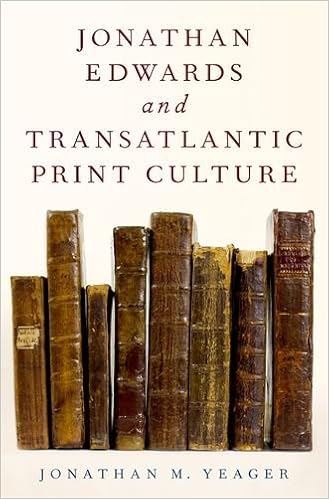
Last summer, when I was taking a Rare Book School course at the Library Company of Philadelphia, I had the archive's photographer take digital images of several first edition books by Jonathan Edwards, with the intent that one of these pictures could be used for the cover. I was glad that OUP agreed to use one of the images. The cover for the book consists of spines images (from left to right) of Edwards's Some Thoughts (1742), Religious Affections (1746), Humble Attempt (1748), Freedom of the Will (1754), Original Sin (1758), Life of Edwards (1765), Sermons on the Following Subjects (1780), and A History of the Work of Redemption (1774). I was thrilled to read the blurbs that OUP secured from Catherine Brekus and David Hall of Harvard Divinity School and Ken Minkema of the Jonathan Edwards Center at Yale.
My remaining summer schedule will consist of some fly fishing at the Hiwassee River and Tims Ford Dam in Tennessee, surfing at Carolina Beach, NC, a family reunion in the Pittsburgh, PA area, redoing my Modern Christian Thought course, creating the lectures for a new gen ed course at UTC on the History of Christianity, and taking a seminar at Princeton University's Witherspoon Institute on "Religion and Liberty in the American Founding Era" taught by Daniel Dreisbach, Thomas Kidd, and Gerald McDermott. It should be a great summer!
Last summer, when I was taking a Rare Book School course at the Library Company of Philadelphia, I had the archive's photographer take digital images of several first edition books by Jonathan Edwards, with the intent that one of these pictures could be used for the cover. I was glad that OUP agreed to use one of the images. The cover for the book consists of spines images (from left to right) of Edwards's Some Thoughts (1742), Religious Affections (1746), Humble Attempt (1748), Freedom of the Will (1754), Original Sin (1758), Life of Edwards (1765), Sermons on the Following Subjects (1780), and A History of the Work of Redemption (1774). I was thrilled to read the blurbs that OUP secured from Catherine Brekus and David Hall of Harvard Divinity School and Ken Minkema of the Jonathan Edwards Center at Yale.
My remaining summer schedule will consist of some fly fishing at the Hiwassee River and Tims Ford Dam in Tennessee, surfing at Carolina Beach, NC, a family reunion in the Pittsburgh, PA area, redoing my Modern Christian Thought course, creating the lectures for a new gen ed course at UTC on the History of Christianity, and taking a seminar at Princeton University's Witherspoon Institute on "Religion and Liberty in the American Founding Era" taught by Daniel Dreisbach, Thomas Kidd, and Gerald McDermott. It should be a great summer!
Wednesday 20 April 2016
More Books That I Am Reading

 Two new books arrived in the mail today. I look forward to reading George Marsden's new biography of C. S. Lewis's Mere Christianity. As a member of the C. S. Lewis lecture committee at UTC, I hope to nab George Marsden for our next annual lecture. The other book that I recently received was John Fea's The Bible Cause, which chronicles a history of the American Bible Society. I talk quite about about the American Bible Society in my annual course at UTC on "Religion in American Life," and so I imagine that Fea's work will be very useful for me.
Also, today I noticed that Jonathan Edwards and Transatlantic Print Culture is now available for pre-order on OUP.com and Amazon.com--still waiting on the cover art for the dust jacket and the blurbs.
Subscribe to:
Posts (Atom)