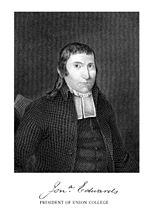
Showing posts with label Jonathan Edwards Jr.. Show all posts

Friday, 2 October 2015

More Cool Antiquarian Books!

Today, I am reporting on three antiquarian books that arrived in the mail within the last week. This will (most likely) be my last purchases for the foreseeable future since my personal and professional book budget is nearly depleted at this point.

Remarks on Important Theological Controversies (Edinburgh, 1796)--Signed by Jonathan Edwards, Jr. in 1797

Book #1: Remarks on Important Theological Controversies
Arguably, the coolest book that arrived by post a few days ago is a first edition of Remarks on Important Theological Controversies, published at Edinburgh in 1796. This is the last posthumous book by Edwards that his son Jonathan Edwards, Jr. transcribed and sent to John Erskine at Edinburgh to edit and publish. For this second volume of Jonathan Edwards Sr.'s "Miscellanies," Edwards, Jr. made arrangements once again to have the Edinburgh bookseller Margaret Gray publish this posthumous book. Through Erskine's influence, Margaret and her father William had been the leading publishers of Edwards's books in Scotland in the latter half of the century. William Gray's first Edwards publication was a 1765 edition of The Life of David Brainerd. Later, in 1774, he published the first edition of A History of the Work of Redemption, which represents the first posthumous work that Edwards, Jr. and Erskine collaborated in transcribing and editing.

After William Gray died in the mid-1780s, his daughter Margaret took over the family bookselling business and began publishing more of Edwards's writings at Edinburgh. The first book by Edwards that she published was Sermons on Various Important Subjects in 1785. This volume included all five sermons in Edwards's Discourses on Various Important Subjects, published at Boston in 1738, plus "God Glorified in the Work of Redemption,""Sinners in the Hands of an Angry God," and his "Farewell Sermon." Margaret Gray later reprinted A History of the Work of Redemption in 1788 and 1793. She also published a series of never before printed Practical Sermons by Edwards in 1788. In 1789, she published Edwards's Twenty Sermons, which included the same set of fifteen Sermons on the Following Subjects that Edwards, Jr. transcribed and had printed at Hartford in 1780, plus "A Divine and Supernatural Light," "The Church's Marriage to Her Sons, and to Her God" "True Saints, When Absent from the Body, Are Present with the Lord," "God's Awful Judgement in the Breaking and Withering of the Strong Rods of a Community," and "True Grace Distinguished from the Experience of Devils." Her final book by Edwards was Miscellaneous Observations on Important Subjects, the first volume of edited Miscellanies, published in 1793.

When Margaret Gray died one year later, her apprentice James Galbraith partnered with an up-and-coming bookseller named Archibald Constable, who would go on to be Sir Walter Scott's chief publisher, to issue Remarks on Important Theological Controversies in 1796. Although Erskine hoped that Edwards, Jr. would transcribe a third volume of his father's Miscellanies to be published in Scotland, the son could not find the time to complete a third volume. Edwards, Jr. had recently relocated from New Haven to Colebrook, Connecticut to be a pastor of a church from 1795 until 1799. He then took a position as the president of Union College in Schenectady, New York before passing away in 1801. With all of these changes, it seems that he could not carve out some time to complete a third volume of father's Miscellanies.

The copy of Remarks on Important Theological Controversies that I recently purchased is not only valuable to me because it is the last book by Edwards that his son transcribed and published, but it also happens to be Edwards, Jr.'s personal copy! On the flyleaf page, you can see that Jonathan Edwards, Jr. signed his name in 1797 (before being passed on to Mary Edwards). The book was bound in calfskin, and on the back board, you can see that it showcases a "tree" style staining, whereby the finisher would use a mixture of pearl ash and copperas to create a tree shape pattern. This kind of elaborate binding style seems fitting for a presentation copy to the editor of this work.

Book #2: Religious Affections, Second Edition (Boston, 1768)
Religious Affections (New York, 1768)
Another book that I added to my collection this week is the second edition of Edwards's Treatise Concerning Religious Affections, reprinted at New York by James Parker for the bookseller Garrat Noel. I have been wanting a copy of this particular book because of the history behind this publication. The August 4, 1768 issue of The New-York Journal advertised Noel's second edition as "neatly bound" and on "handsome type" for eight shillings. I concur with this advertisement, that the book is attractively bound, especially for a colonial book. Later, this book was reissued by the London bookseller George Keith. Although Keith called his book the "fourth edition," there is no doubt that it is a reissue of Noel's second edition falsely advertised on the title page. I think that what happened in this case is that Noel's second edition did not sell well, and so he probably sold his remainder copies to Keith, who remarked them falsely as the "fourth edition" to unsuspecting Londoners.

Book #3: Religious Affections (Elizabethtown, 1787)
Religious Affections (1787) on mottled calfskin, made by sponging the boards with acid or dyes
This final book that arrived in the mail this week is also significant to my research on the history of Edwards's publications. This particular edition of Religious Affections was printed in Elizabethtown by Shepard Kollock for the New York bookseller Robert Hodge. I have posted about Hodge before, saying that he had such great success publishing a new edition of A History of the Work of Redemption in 1786, that he decided to sponsor a new edition of Religious Affections one year later. This edition of Religious Affections, however, was not as successful. Whereas 476 people subscribed for 736 copies of his edition of A History of the Work of Redemption, only 308 people subscribed for 462 copies of his edition of Religious Affections.

I am currently working with UTC's GIS manager Andy Carroll to plot four of Edwards's subscription lists, including those found in Hodge's editions of A History of the Work of Redemption and Religious Affections. I hope to share our work soon, but for now, I will end this post by showing you that my copy was formerly owned by the Newark minister Uzal Ogden, a subscriber for the book, who signed his name above the title page, and indicated that he paid the subscription price of ten shillings at the time that it was published in 1787.
Uzal Ogden signs his name in 1787 above the title page, and the price of 10s. that he paid
Ogden's name appears on the subscription page in the "O" section

Saturday, 18 May 2013

An Early Evangelical that Didn't Make the Cut--Part III

The availability of Doug Sweeney's and Allen Guelzo's The New England Theology: From Jonathan Edwards to Edwards Amasa Park convinced me not to include the introduction and excerpt of Jonathan Edwards Jr. in Early Evangelicalism: A Reader. Sweeney and Guelzo have put together an excellent anthology on many of the "New Divinity" followers of Edwards, including the writings of Jonathan Edwards Jr.


Jonathan Edwards Jr.
            Arguably, the most critical comments on eighteenth-century American revivalism came from Charles Chauncy (1705-87), the Boston Old Light Congregational minister. In his Seasonable Thoughts on the State of Religion in New England (1743), Chauncy denounced the Great Awakening as a festival of “enthusiasts” rather than a venue for godly renewal in the colonies. Chauncy abhorred the preaching and excessive emotionalism of the revivals, convinced that God desired an orderly and rational form of Christianity antithetical to the kind of religion nurtured by the New Lights. Although in many ways an ardent defender of traditionalism in New England committed to maintaining a hierarchy with clergymen as society’s ruling elites, Chauncy strayed from the orthodox Calvinistic beliefs of his forefathers on soteriology. In his research, Chauncy came to an Arminian understanding of salvation whereby Christ died not only for the elect, but for the whole of humanity.

Around mid-century, Chauncy began working on more radical alterations of traditional doctrines in a manuscript he dubbed as “the pudding.” When served, the pudding carried with it the taste of universalism whereby Chauncy proclaimed that God’s love could not allow sinners to experience the torrents of everlasting punishment. Rather, hell was an intermediate place where the unrepentant would suffer for a period of time in proportion to the crimes committed while on earth. For Chauncy, it seemed logically impossible for a benevolent deity to create anything that would not be brought to an ultimate state of happiness. In the end, everyone would enter a final stage of eternal bliss. Chauncy’s formerly clandestine views on universalism surfaced in the 1780s in a number of works, including his Divine Glory Brought to View in the Final Salvation of All Men (1783), The Benevolence of the Deity (1784), The Mystery Hid from Ages and Generations Made Manifest by the Gospel-Revelation (1784), and Five Dissertations on the Scriptural Account of the Fall (1785).

            As a response to Chauncy, Jonathan Edwards Jr. wrote The Salvation of All Men Strictly Examined in 1790. Having studied theology under Joseph Bellamy, the younger Edwards was aptly prepared to engage his father’s nemesis. A long and theologically technical specimen, The Salvation of All Men was an attempt to refute Chauncy’s justification for universal salvation with logic and biblical evidence. Edwards charged Chauncy with a number of inconsistencies on issues pertaining to the definition of justice, but one of his most effective critiques had to do with the necessity of Christ’s death. The younger Edwards wondered why Christ needed to die if a person could serve time in a state of intermediate punishment. If a person essentially pays for crimes committed during his or her lifetime, has that individual earned the right to enter the final stage of happiness without the benefit of divine grace? Edwards Jr. believed that in denying the existence of hell as an eternal designation for the unregenerate, Chauncy had reduced the consequences of sin and made Christ’s death on the cross meaningless.

The Salvation of All Men Strictly Examined
            Beside the doctrine of the salvation of all men, to establish which is the design of his [Chauncy’s] whole book; there are several other doctrines, which may be considered as fundamental to his system. He does not deny all future punishment of the wicked; but allows that they will be punished according to their demerits, or according to strict justice. Thus he allows that “many men will be miserable in the next state of existence, in proportion to the moral depravity they have contracted in this. There is no room for debate here… They must be unavoidably miserable in proportion to the number and greatness of their vices… For the wages of sin is death; but the gift of God is eternal life through Jesus Christ our Lord: i.e. if men continue [as] the servants of sin, the wages they shall receive, before the gift through Christ is conferred on them, will be the second death.” If some men suffer that punishment which is the wages of sin, they doubtless suffer all which they deserve. No man deserves more than his wages. “In the collective sense, they will be tormented for ages of ages; though some of them only should be tormented through the whole of that period; the rest variously as to time, in proportion to their deserts… There shall be a difference in the punishment of wicked men, according to the difference there has been in the nature and number of their evil deeds.” He speaks of the wicked as liable “to positive torments awfully great in degree, and long in continuance, in proportion to the number and greatness of their crimes…
            Another fundamental principle of Dr. C’s book, is, that all men, both those who are saved immediately from this life, and those who are saved after they have suffered the pains of hell; are saved by the mere mercy, compassion, grace or favor of God, through Christ. He allows, that the Apostle’s doctrine of justification stands “upon the foot of grace through Christ,” and “that mankind have universally sinned and consequently cannot be justified upon any claim founded on mere law… The gift by Christ takes rise from the many offences, which mankind commit in their own persons, and finally terminates in opposition to the power and demerit of them all, in their being restored, not simply to life but to reign in it forever… As mankind universally are subjected to damage through the lapse of Adam; so they shall as universally be delivered from it, through the gift by Christ… The gift on Christ’s part ought to be taken in its abounding sense… The plain truth is, final everlasting salvation is absolutely the free gift of God to all men, through Jesus Christ he has absolutely and unconditionally determined, of his rich mercy, through the intervening mediation of his son Jesus Christ; that all men, the whole race of lapsed Adam shall reign in life.” He speaks of God as exercising pity, tender compassion and grace, towards the damned; and speaking of the disciplinary punishment of the damned, he says, “that God, in the other world as well as this, must be disposed to make it evident, that he is a being of boundless and inexhaustible goodness.” He “speaks of the doctrine of universal salvation, as the gospel plan of mercy extensively benevolent; and a wonderful design of mercy” as “the scripture scheme of mercy,” and of the vilest of the human race as “the objects of mercy.” He quotes with approbation, from Mr. Whiston, “That there may be in the utmost bowels of the divine compassion, another time of trial allotted” to the damned, “in which many or all of them may be saved, by the infinite indulgence and love of their Creator.”
            Our author abundantly declares also, that this rich mercy, this free gift, this tender compassion and grace, this infinite indulgence and love of their Creator, this boundless and inexhaustible goodness, in the salvation of all men, is exercised through Christ only, and for his sake. “Jesus Christ is the person through whom and upon whose account, happiness is attainable by any of the human race… The obedience of Christ, and eminently his obedience unto death, is the ground or reason, upon which it hath pleased God to make happiness attainable by any of the human race… It was with a view to the obedience and death of Christ, upon this account, upon this ground, for this reason, that God was pleased to make the gospel promise of a glorious immortality to the sons of men… Christ died not for a select number of men only, but for mankind universally and without exception or limitation.”
            Now, how can this part of Dr. C’s system be reconciled with that part, in which he holds, that all the damned will be punished according to their deserts? Can those who are punished according to their deserts, after that be saved on the foot of grace through Christ? Can those who are punished according to the nature and number of their evil deeds; in degree and continuance, in proportion to the number and greatness of their crimes; in whose punishment the divine law takes its course, and the threatened penalty is fully executed: can these persons be saved by a gift? by a gift taken in the abounding sense? by the free gift of God through Christ? by rich mercy? by pity, tender compassion and grace? by mercy extensively benevolent? by a wonderful design of mercy? by boundless and inexhaustible goodness? by the utmost bowels of the divine compassion? by the infinite indulgence and love of their Creator? Is the man who by his crimes has, according to law, exposed himself to the pillory, or to be cropped and branded, and on whom the law has taken its course, and the threatened penalty has been fully executed; is he after all delivered from further suffering by grace, by pity, by tender compassion, by indulgence and love, by the utmost bowels of compassion? No; he has a right on the foot of mere law, and of the most rigorous justice, to subsequent impunity, with respect to the crime or crimes, for which he has been thus punished: and to tell him after he is thus punished, that he is now released by grace, by pity, by utmost compassion, by indulgence and love, would be the grossest insult.
            Again; how can those who have been punished according to their deserts, be saved through Christ, or on his account? How can the obedience and death of Christ be the ground or reason of their salvation? Having suffered the full penalty threatened in the law, they have a right to demand future impunity, on account of their own sufferings. What need then have they of Christ, of his obedience and death, or of his mediatory intervention, to be brought into the account? Dr. C. speaks of the “deliverance” or “the redemption which Christ has purchased” for all men. But what need is there, that Christ should purchase deliverance for those, who purchase it for themselves, by their own personal sufferings?
Jonathan Edwards Jr., The Salvation of All Men Strictly Examined, and the Punishment Of Those Who Die Impenitent, Argued and Defended Against the Objections and Reasonings of the Late Rev. Doctor Chauncy, of Boston, in His Book Entitled, “The Salvation of All Men” (New Haven: A. Morse, 1790), 1-2, 8-10.

Thursday, 31 January 2013

Jonathan Edwards, Jr.

Why isn't there very much scholarship on Jonathan Edwards, Jr? I'm doing research on Edwards the Younger as part of a book-length project, and I am amazed at how little has been written about this influential minister and theologian. Robert L. Ferm's Jonathan Edwards the Younger, 1745-1801: A Colonial Pastor (1976) is the only major modern work published on Jr. The next best source (and in many ways a more thorough analysis of Edwards Jr. within his cultural context) is Ken Minkema's 1988 PhD dissertation, "The Edwardses: A Ministerial Family in Eighteenth-Century New England," which is divided into three sections on Timothy Edwards, Jonathan Edwards (1703-58), and Edwards, Jr. As Minkema shows in his thesis, there are numerous manuscript sermons from Jr. that scholars can use to study his thought.

His life would also make an interesting story. He was raised at Stockbridge, MA, learned the local Native American dialect (publishing a work on the Mahican dialect), pastored a church at New Haven where the politician Roger Sherman attended, experienced the tragedy of his first wife drowning in 1782, and was an ardent supporter of Federalism. There are also all kinds of similarities with his father that could be explored, including  his dismissal at New Haven, his desire to seek literary fame, and the fact that he finished his career as the president of a school (Union College in Schenectady, NY).

Given the number of books and articles on Jonathan Edwards, Sr., someone writing on Jr. could stand out by breaking away from the pack and bringing to light this neglected figure.