Sunday, 12 August 2012

Uncatalogued Samson Occom Letter at the New York Public Library

Here is some evidence that the Miscellaneous Personal Name File at the New York Public Library contains hidden treasure.

A few days ago, I began reading Joanna Brooks's The Collected Writings of Samson Occom, Mohegan in order to write my introduction for Occom in my forthcoming book, Early Evangelicalism: A Reader.  Brooks has done a wonderful service for religious scholars by editing all of the known letters, journals, and publications of Occom. The book is extremely thorough and well organized.

I recalled that I had examined a letter in the Samson Occom file at the New York Public Library and so I got out my copy of the manuscript and attempted to read it. Because of the difficulty of the handwriting and quality of the copy, I decided to ease my burden by consulting Brooks's edited book in order to read her transcription of it. My copy of the letter, however, wasn't listed in her volume. It seems that this is a prime example of the potential hidden treasure that awaits scholars willing to mine the Personal Name File at the NYPL, a topic that I recently blogged about.

I have since contacted Dr. Brooks, asking her to review my introduction and excerpt on Occom. She seemed elated to learn of a new Occom letter.

Founding Fathers

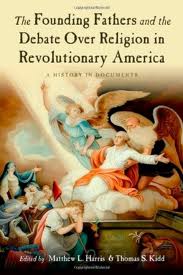
I have been doing some light reading to determine the possibility of teaching a course on "Faith and the Founding Fathers." After reading about half of John Fea's book, Was America Founded as a Christian Nation? and The Founding Fathers and the Debate over Religion in Revolutionary America, edited by Thomas Kidd and Matthew Harris, I was convinced that such a course would be interesting and informative for students. I find the debate over Washington's faith particularly interesting since in some ways he seemed ambivalent toward Christianity, yet he surpassed the other Founders in his reliance on God's providence.

As far as a textbook goes, I may use the reader by Kidd and Harris or James Hutson's The Founders on Religion: A Book of Quotations. I ordered the latter along with four other  books on the founders and their view of religion.


Thursday, 9 August 2012

Review of Enlightened Evangelicalism in Church History

It was bound to happen, but I received my first harsh review of Enlightened Evangelicalism: The Life and Thought of John Erskine in the latest edition of Church History. The reviewer is J. Stewart Brown, Professor of Ecclesiastical History at the University of Edinburgh in Scotland.

Brown calls the monograph a "well-researched biography," but then goes on to chide me for representing Erskine as an enlightened figure. Brown sees Erskine as simply a confessional Calvinist who "had little confidence in the natural capacities of a depraved humankind and little interest in social progress." Brown goes on to say, "Nor did he exhibit the Enlightenment virtue of toleration." Here, Brown uses my own research against me, citing Erskine's hostility towards John Wesley and Roman Catholicism. Further proof to Brown that Erskine was in no way enlightened is the fact that three of his 1765 theological treatises were not previously published. The inference is that an "enlightened" author would have also been a best-selling author. Such an assessment makes me wonder if Brown has actually read my book.

Throughout Enlightened Evangelicalism I argue that Erskine did have confidence in human reason. I discuss this issue at length, particularly in the chapter on Erskine's theological treatises, in which one of his treatises centers on the human capacity for natural reason. On the issue of tolerance, Brown is right that Erskine opposed Wesley and Roman Catholicism, but in the book I demonstrate the ways in which Erskine differentiated himself from others in Scotland by peacefully opposing Wesley and Catholicism in print and by legislative means. Erskine never participated in the anti-Catholic riots in Edinburgh and Glasgow, and ardently preached against such violence. In writing the book, I wondered if I had said too much about how Erskine differentiated himself from former seventeenth-century divines (especially in his rhetoric and theology), but somehow Brown came away with the conclusion that Erskine "was a pawky, old-style Calvinist, who looked back to the early seventeenth century."

In the second half of the review, Brown offers some favorable comments about my chapters on Erskine as a friend to America, and as a disseminator of books. But in his overall assessment he charges me with not being critical enough of Erskine. This is an interesting and somewhat surprising conclusion, given that he had previously used my criticism of Erskine's stance against Wesley and Catholicism to serve his interest of describing Erskine as intolerant.

Brown's review does not surprise me all that much. In the introduction to his edited book William Robertson and the Expansion of the Empire, he praised Robertson as a personal hero who built up Edinburgh University. Unfortunately, in Enlightened Evangelicalism, Robertson does not fare so well. By comparison to Erskine, I characterize Robertson as self-centered and interested in fame and glory at the expense of his pastoral ministry. My hunch is that Brown took offense at my depiction of Robertson and decided to let out some steam. While it would have been interesting if had the chance to respond to his review in print, I accept this aspect of scholarship. But of all the journals to print this kind of review, why did it have to be my favorite one!

More reviews to come... Isabel Rivers in the Journal of Ecclesiastical History and others to follow.

Wednesday, 8 August 2012

Was Isaac Watts an Evangelical?

As I am finishing up my evangelical anthology, I have to decide if I should include Isaac Watts. I'm not sure that there is a certain answer on whether he was an evangelical. He certainly corresponded with leading evangelicals in America and Britain, but there are reports of him holding unorthodox views of the Trinity later in his life. In her entry in the Oxford Dictionary of National Biography, Isabel Rivers brushes off claims of his heterodoxy, arguing that he simply struggled to express his views of the Trinity clearly. Perhaps he is the "Bonhoeffer" of his day, with liberals and conservatives both wanting to claim him for their party.

Any thoughts on how one should categorize Watts?

Monday, 6 August 2012

Who is Philip Doddridge?

One of the most important early evangelicals has been almost entirely forgotten. His name is Philip Doddridge. I realized this black hole of scholarship while looking for a biography on Doddridge so that I could write a brief introduction to his Rise and Progress of Religion in the Soul (1745).

It seems that the best work done on Doddridge was years ago by Geoffrey Nuttall, who recognized Doddridge's significance. Among his books, Nuttall published Philip Doddridge: 1701-52: His Contribution to English Religion (1951), Philip Doddridge and the Netherlands (1987), co-edited by Nuttall and J. Berg, and a collection of Doddridge's letters in 1979. More recently, there have been mostly popular books on Doddridge, including Malcolm Deacon's Philip Doddridge of Northampton, 1702-51 (1980) and Alan Clifford's The Good Doctor: Philip Doddridge of Northampton (2002). What looks like an important book on Doddridge's hymns has recently been edited by Graham Ashworth and published by Reformation Heritage Books. As thankful as I am for these resources, there should be a lot more published on Doddridge, given his importance.

Doddridge was arguably the most significant Dissenter of the eighteenth century. His books, especially his Rise and Progress, were read by nearly every notable evangelical at that time. He trained future ministers at his highly acclaimed Academy at Northampton, tolerated religions other than his own, and read widely on the subjects of philosophy and religion.

All this to say: will someone please write a critical biography of Doddridge with a university press!!??

Saturday, 4 August 2012

William Williams

In the opening ceremonies of the 2012 Olympic Summer Games in London, all the countries of Great Britain were represented: England, Scotland, Wales, and Northern Ireland. If you recall, the children's choir for Wales sang William Williams's hymn, "Guide me, O Thou great Jehovah." I was particularly in tune to hear this song since I had just finished reading Eifion Evans's book, Bread of Heaven: The Life and Work of William Williams, Pantycelyn.

Evans has done a service to scholars like me who cannot read Welsh. Outside of his book, there are only sparse references (in English) to Williams's significance to early evangelicalism. Overall, the book is a very good monograph, but with some significant weaknesses. For me, the first third of the book was the most enjoyable to read because it contained the best contextual information on Williams's background as a farmer, his conversion after hearing a sermon by Howell Harris, and his entrance into the ministry. In the last two-thirds of the monograph, however, there is very little historical information on Williams's life and the division that occurred in the 1750s between Howell Harris, on the one hand, and Daniel Rowland and Williams, on the other. In the latter two-thirds, Evans spends more time looking at Williams's theology, making the case that (unsurprisingly) he was a good Calvinistic Methodist.

While I appreciated the research that no doubt was undertaken for this project, I was disappointed on the minimal contextual information on Williams's hymns, especially his most famous song, "Guide me, O Thou great Jehovah." It is not entirely clear in Evans's book when Williams penned the famous lyrics for this hymn (which he did in Welsh), when Peter Williams translated the first version into English, when W.Williams edited Peter Williams's translation, and when and where the first versions of this hymn came into print. From my own research, I determined that the first English version of "Guide me, O Thou great Jehovah" appeared in 1774 as a "supplement" to the nineteenth edition of George Whitefield's Collection of Hymns for Social Worship, with subsequent publications including the hymn. Perhaps the circumstances of this part of Williams's life could not be ascertained, but because of the significance of the hymn, I wished Evans had showed more of an effort in finding out these details. All criticism aside, this is the best introduction on Williams in English. Readers interested in transatlantic evangelicalism will find Evans's book a helpful entry point on one of the best known Welshmen of the eighteenth century.

Friday, 3 August 2012

New Spring Course

For spring 2013, I am thinking about offering a new course at UTC. Which of the following sounds the most interesting?

The Faiths of the Founding Fathers

Jonathan Edwards

World Christianity

All three courses would be new to me, meaning that I would need to develop lectures and design a syllabus. In terms of knowledge, the easiest to design for me would be a course on Jonathan Edwards. I am sure that there would be plenty of material on Edwards. There is a new book out by Michael McClymond and Gerald McDermott on Jonathan Edwards's theology and there is a very inexpensive anthology that I could use entitled, A Jonathan Edwards Reader. But would undergraduates at a regional state school want to take an elective course on such a specific person?

For "The Faiths of the Founding Fathers," we would look at the various religious beliefs of America's Founders, including John Adams, Benjamin Franklin, Thomas Jefferson, George Washington, and John Witherspoon. I would be somewhat familiar with most of the material in designing this course.

The last option would be the most difficult for me: a course on World Christianity. But, it could be the most appealing to students, given the current interest in that topic. I see lots of faculty job ads for specialists on World Christianity and so it may be a good idea to add a course like this on the cv.

Let me know what you think.

Thursday, 2 August 2012

Who are the leading 18th-century evangelicals?

Who are the leading eighteenth-century evangelicals? Certainly Jonathan Edwards, John Wesley, and George Whitefield would top the list. But after that, who else would you name? Mark Noll's The Rise of Evangelicalism: The Age of Edwards, Whitefield and the Wesleys is a good place to start for compiling such a list.

Has anyone ever heard of these people: Anne Dutton, Thomas Foxcroft, Phillis Wheatley, Hannah Heaton, Hugh Kennedy, William Grimshaw, Sarah Prince Gill, Samuel Walker, Freeborn Garrettson, James Hervey, Robert Walker, Anne Steele, Thomas Prince, William Romaine, Thomas Haweis, John Maclaurin, Daniel Rowland, William Williams, Henry Alline, Charles Nisbet, Robert Sandeman, Charles Simeon, Lemuel Haynes, and Jedidiah Morse? Even though these evangelicals have been forgotten, they were very important to the transatlantic movement that scholars call evangelicalism.

Are there any other evangelicals in the eighteenth century who have not received their fair share of scholarly attention?