Wednesday, 10 July 2013

Emma Macleod's Newest Book

Emma Macleod, my second doctoral supervisor at the University of Stirling, informed me that her next book is out, British Visions of America, 1775-1820. This monograph is in Pickering & Chatto's "Enlightenment World" series.

Here is the book's description:

In the late eighteenth and early nineteenth centuries Britain’s perception of America varied between a set of colonies, a utopia, a market and an experiment. Macleod examines changing British conceptions of America across the political spectrum during a period of political, cultural and intellectual upheaval. These shifting perceptions are in evidence in the writings of political commentators including Samuel Johnson, Thomas Paine, John Gifford, William Cobbett and Samuel Taylor Coleridge.

I look forward to reading it. Congratulations Emma!

Tuesday, 9 July 2013

New Review of Enlightened Evangelicalism

Check out the latest review of Enlightened Evangelicalism: The Life and Thought of John Erskine in The English Historical Review. Alasdair Raffe, who earned a PhD in Scottish history at Edinburgh University and teaches at Northumbria University in England, has written a fair review of my book. In terms of criticism, Raffe argues that I didn't give enough attention to political issues in the book, and that some of my chapters are more original than others. He also is not that excited about including Erskine as an "enlightened" figure. But on the whole, Raffe credits these as "minor objections to a fine and welcome book."

Below are some of the highlights:

John Erskine (1721–1803) was one of eighteenth-century Scotland’s most prominent clergymen. Of noble birth and considerable wealth, he was a minister of the important church of Greyfriars, Edinburgh, from 1758 until his death. His sermons were well regarded, his publications influential, and his correspondence was both extensive and international...

Throughout, the book is well written and engages intelligently with the most recent scholarship on the Enlightenment and eighteenth-century religion...

Yeager convincingly depicts Erskine as a progressive intellectual: he was considerably more flexible in his attitudes than Scottish presbyterians of earlier generations. And he surpassed his conservative contemporaries in the range of his learning and his willingness to experiment in the hinterland of Calvinist orthodoxy. At the same time, he was more insistent than his Moderate brethren on the gospels’ core message of salvation...

Yeager shows us that Erskine was at once part of the mainstream of religious life in the eighteenth century, and central to many of our historiographical concerns.

As far as I know, this is the thirteenth review of Enlightened Evangelicalism, and I am very grateful  for this even-handed critical appraisal of my book from a scholar who I don't know personally.

Edmund S. Morgan Remembered

The great historian Edmund S. Morgan died last night at age 97. My favorite book by him is his biography of former Yale College president Ezra Stiles, The Gentle Puritan.

I remember auditing a summer course at Regent College with George Marsden a few years ago and talking with him about Morgan's wonderful biography of Stiles. Marsden informed me that he once served as a TA for Morgan as a graduate student at Yale, and later wrote Morgan a note expressing his admiration of how The Gentle Puritan provided a model for how to write Jonathan Edwards: A Life.

Sunday, 7 July 2013

Ivanhoes!


Yesterday and today my family and I drove from home from Michigan. Driving near Upland, Indiana, we had to make a stop at Ivanhoes for lunch and dessert. Located across the street from the campus of Taylor University (my alma mater), Ivanhoes boasts one hundred different shakes and sundaes. My favorite sundae has chocolate ice cream topped with hot fudge and Reeses hot peanut butter sauce. Although known for its ice cream, Ivanhoes also has excellent food (the pulled pork sandwich is the best I have ever had). The next time you are driving on I 69, and are looking to make a pit stop, consider stopping at exit 159 to eat a meal at Ivanhoes. You won't be disappointed.

Friday, 5 July 2013

Look Inside "Early Evangelicalism: A Reader"

I learned a few days ago that the final revisions for Early Evangelicalism: A Reader have been completed by the editors at Oxford University Press. The "look inside" feature is now available on Amazon.com. Take a look at some of the introductions and excerpts and let me know what you think.

Thursday, 4 July 2013

F. F. Bruce: A Productive Life

I finally finished Tim Grass's F. F. Bruce: A Life, which took me all week to read. I was attracted to the book because of Bruce's connection with the Plymouth Brethren, a denomination which I studied for my master's thesis at Regent College. I have fond memories of talking about Brethren ecclesiology with Bruce's former student Ward Gasque in Vancounver as well as J. I. Packer, who served as the supervisor for my thesis. Each time that I met with Dr. Packer, he would mark up the drafts of my thesis in pencil with various corrections. Amazingly, Dr. Packer would refer to footnotes in my thesis by memory.
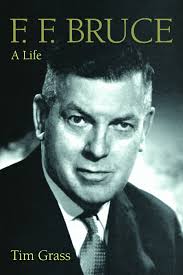
Growing up in an unofficial Brethren church in Toledo, Ohio, I wanted to learn more about this denomination while answering questions that pertained to its ecclesiology. I wondered why our church did not have a pastor, why it was run by elders, and why we held a "Breaking of Bread" service each Sunday. Furthermore, in retrospect, it seemed striking to me that so many laypeople in our church knew the Bible backwards and forwards. I cannot think of any church that I have attended since in which the congregants knew scripture as well. With this background in mind, I was excited to pick up Tim Grass's biography of F. F. Bruce last week at the Eerdmans bookstore in Grand Rapids.

Bruce is the most important Brethren scholar in the latter half of the 20th century, establishing himself as a preeminent New Testament scholar while holding the Rylands Chair of Biblical Criticism and Exegesis at Manchester University. From Grass's account, Bruce's life was not all that exciting. The book is nothing like the page-turning biography of C. S. Lewis by Alister McGrath. What I found to be the most impressive aspect of Bruce's life was his literary output (Grass helpfully provides a bibliography of Bruce's works at the end of the book), writing some fifty books, hundreds of articles, and roughly two thousand reviews while somehow managing to serve his church, raise a family, and mentor dozens of students. I also was amazed at the breadth of Bruce's scholarship, with expertise on not only ancient languages and biblical studies, but also extending his interests into church history and practical theology.

While Bruce maintained his allegiance to the Brethren, he did not shy away from criticizing some of the denomination's most cherished distinctives, such as premillennial dispensationalism and its ban against women in ministry. Because of his failure to adopt some traditional Brethren beliefs, he was not universally appreciated by everyone in the denomination. Some, for instance, criticized him for supposedly liberalizing Brethren doctrines.

Bruce's greatest impact seems to have been on the wider evangelical movement. In his conclusion, Grass writes that Bruce's influence on evangelicalism is twofold: "he paved the way for widespread evangelical acceptance of critical methodologies as having a part to play in reverent and submissive biblical study, and for wider academic acceptance of evangelicals as genuine scholars... For many evangelicals, Bruce was 'Exhibit A' as evidence for their claim to have an intellectually credible position" (217). Bruce helped contribute to the push among current evangelicals to establish themselves as respected scholars at secular institutions in the academe. For people interested in biographies on the forerunners of contemporary evangelical scholarship--Carl F. H. Henry, George Eldon Ladd, and others.--Grass's book is a good place to start.


Wednesday, 3 July 2013

Bill McClay Leaves UTC

It's official, Bill McClay is leaving his position as the Sun Trust Bank Chair of Excellence in Humanities at UTC to take the G. T. and Libby Blankenship Chair in the History of Liberty at Oklahoma University. While I congratulate him on his new position, I am deeply saddened by his departure. You will be missed Bill!


Tuesday, 2 July 2013

Wilberforce Family and Friends Revisited

It is hard to believe it has been one year since I read Anne Stott's Wilberforce and Friends. Below is the brief review that I posted exactly one year ago. 

The Clapham Sect: Family and Friends

I am now in West Michigan, enjoying the cooler weather and time with my extended family. While at North Carolina, I had the chance to finish reading Anne Stott's latest book, Wilberforce: Family and Friends. I think that the book is misnamed. The title should be, The Clapham Sect: Family and Friends, since it evenly distributes information on the Wilberforces, the Thorntons, the Stephens, the Macaulays, and Hannah More.

The book is interesting, but must not be mistaken as light reading. It is in many ways a more detailed and technical work than her previous book on Hannah More. The narrative gets bogged down in its details at times, and bounces around in terms of dates. I also had trouble keeping track of the extensive names and connections among the Clapham Sect. These negative features, however, do not detract from the book's significant strengths. I was fascinated by the story that Stott constructed about the children of the Clapham Sect. William Wilberforce Jr. is especially interesting in that he seemed to be openly defiant to his father's evangelical faith. Junior was reportedly mischievous and viewed as a bad influence by the Thorntons, who wanted to guard their children from him. The final chapters of the book provided interesting material on the legacy of the Clapham Sect and what happened religiously with the second and third generation, many of whom veered away from the religion of their parents. All this to say, I would categorize the book as a true monograph that should not be read by a lay audience. I was therefore surprised to see the book sold at chain bookstores, such as Waterstone's and Blackwell's in Britain.

For any scholar who wishes to avoid a hagiographic depiction of Wilberforce and/or the Clapham Sect, Wilberforce: Family and Friends will be required reading since it offers an extensive report on this interesting network of early nineteenth-century evangelicals.