Thursday, 12 January 2012

Philip Jenkins at UTC


Renowned author and speaker Philip Jenkins will be coming to UTC in the spring of 2013. Jenkins, who has published over two dozen books, will be talking on a topic pertaining to global Christianity, which is the theme for the spring 2013 LeRoy Martin Distinguished Lecturer Series.

Tuesday, 10 January 2012

Scripture and Church: Calvin, Servetus and Castellio


Bruce Gordon is coming to UTC to give a lecture at 7pm on Thursday, January 19 in the Raccoon Mountain Room. This is the second lecture in the LeRoy Martin Distinguished Lecturer Series. The title of his talk is "Scripture and Church: Calvin, Servetus and Castellio." This is the abstract of the upcoming lecture:

"The 1550s was a decade of turbulence and conflict for the European Reformation. In German lands war loomed, while in France the reformed faithful suffered severe persecution. In England the young King Edward VI in whom such hopes had been placed was succeeded by his Catholic older sister, Mary. Within the Reformed church there many unresolved questions and tensions. This was evident in the trial and execution of the Spaniard Michael Servetus in Geneva in the autumn of 1553. This notorious case brought together three very different figures: John Calvin, Servetus and Sebastian Castellio. This talk will explore the differences between these men by considering the ways in which they interpreted the Bible and how those readings influenced their understanding of church and reform. The result is a consideration of the different paths the Reformation might have taken during those volatile years."

Bruce has written a wonderful new biography on John Calvin published by Yale University Press in 2009. The book puts flesh on a figure noted for his influential Institutes of the Christian Religion but whose life has been somewhat obscure. Although there is not all that much information on Calvin's person life, Bruce constructs an interesting and seamless narrative that places the great theologian within the context of Renaissance Europe. He also does a masterful job at describing Calvin as a regular person with character flaws, including arrogance and a desire for revenge against his enemies, while at the same time revealing Calvin's strengths, such as human compassion for the poor and desire for ecumenism among the other reformers. Calvin is sure to be the definitive biography of Geneva theologian for many more years to come and I look forward to his lecture at UTC.

Monday, 9 January 2012

The Problem of Christian Scholarship


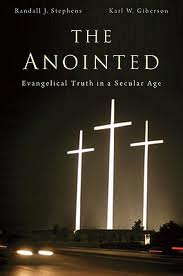
At the AHA/ASCH conference in Chicago, I had the opportunity of listening to an interesting session by Mark Noll and other panelists on the Christian vocation. This seems to be a hot topic based on recent scholarship. I had been hearing a lot of buzz about a book by Randal Stephens and Karl W. Giberson entitled, The Anointed: Evangelical Truth in a Secular Age (Harvard, 2011), and so while at the book exhibit, I purchased it and began leafing through the initial chapters while traveling back to Chattanooga.

I have read about 100 pages of the book so far and can now appreciate the attention that it has received. The introductory chapter points out the irony that many evangelicals would rather learn about science and history from psedo-scholars than established experts with PhDs from prestigious universities. I found the chapter on "The Amateur Christian Historian" particularly interesting, as it implicitly derides evangelicals for accepting the dubious claims of such influential figures as David Barton. While the authors are quick to praise historian Mark Noll, who publicly castigates current trends in providential history, it felt as if Stephens and Giberson were giving too much credit to secular scholarship. That is to say, the underlying message seemed to be: attempts to integrate faith and history should be avoided at all costs. To be fair, I need to finish reading the whole of the book to see if my impression remains the same.

The arguments in the first chapters reminded me of some of the issues raised in the recent book, Confessing History, edited by John Fea, Jay Green, and Eric Miller. While appreciating the work of Marsden, Noll, Hatch and other great historians, some of the essayists complain that evangelical historians are being trained to eschew faith-based assumptions. In order to be accepted in the academy, and perhaps to secure a tenure-track post, must a budding scholar tuck away his or her faith and simply focus on writing good history?

My hope is that there is a via media that avoids the pitfalls of providential history while at the same time does not make historical writing irrelevant to practicing Christians. I abhor reading uncritical, so-called scholarship, but at the same time, I do not want to read or write books that would offer no spiritual nourishment for hungry readers, whether professional scholars or laypeople. It will be interesting to see which Christian historians emerge as the leaders after the Noll-Marsden-Hatch generation.

Jonathan

After Edwards


Capping off the ASCH conference in Chicago was a session, "After Edwards: Appropriations of the New England Theology." A panel consisting of Ken Minkema, David Kling, Anri Morimoto, Ava Chamberlain, and chaired by Oliver Crisp, offered a preview of what to expect in an edited book forthcoming with Oxford University Press. Additional contributors for the book who were not on the panel include Michael McClymond, Gerald McDermott, and Doug Sweeney. The panelists rightly allude to the fact that although Jonathan Edwards has received much scholarly attention, Edwards's so-called New Divinity followers have been largely ignored by the academy. Monographs on Joseph Bellamy, Samuel Hopkins, and Nathaniel W. Taylor have helped religious and intellectual historians understand the scope and breadth of Edwards's legacy, but there is much more to learn about important figures like Levi Hart, Nathaniel Emmons, and Edwards A. Park.

I have thoroughly enjoyed reading the monographs of Kling, Sweeney, and others on the New Divinity and can't wait for this new book to come out later this year!

Jonathan

Saturday, 7 January 2012

Your Time is Up!

A recent session I attended at the ASCH meeting in Chicago reminded me of a problem that plagues conferences: some speakers don't know when to stop talking. Painfully, the audience sits through minute after minute beyond the time allotted without hearing the desired words, "In conclusion..." The audience cannot help but feel bad for the chair of the session as he or she passes note cards to the lecturer, clearly indicating that time is up. Yet, audaciously, the presenter continues onward, perhaps with no indication that the end of the paper is anywhere near.

I wonder what justification such a speaker has for infringing on the time of other lecturers on the panel, embarrassing the chair, and frustrating the audience. Perhaps older professors feel as though the knowledge that they are providing is worth their weight in gold, and consciously or unconsciously believe that no one would mind if they extend their argument into a thirty- or forty-minute discourse. But this problem is not limited to seasoned professionals; younger professors transgress the boundaries of time as well. I wish that presenters would realize that their message would have a greater chance of being received if they adhered to basic elements of courtesy and time management.

Jonathan Yeager

Rewriting American Religious History--The New England Soul


I am currently in Chicago, attending the AHA/ASCH conferences and enjoying every minute of it. The book exhibit provides the ultimate academic bookstore experience and many of the paper presentations have provoked thoughtful discussion on the craft of historical research and writing.

My favorite session so far was "Harry Stout's New England Soul after 25 Years," which took place in the morning on Friday, January 6. The only disappointment of note was the small venue. The program committee clearly did not realize the popularity of this session since chairs had to be quickly assembled outside the conference room, extending several feet beyond the entryway. Mark Noll, Catherine Brekus, James Byrd, Thomas Kidd, and Ken Minkema paid tribute to one of America's leading religious historians.

I have been dwelling on an insight that Stout gave in his parting comments. He explained that after spending over a year of research and writing several hundred pages of the original manuscript, he scrapped his work and started over again. He came to the conclusion that his initial probing into Puritan religious history was simply derivative of Perry Miller's magisterial The New England Mind. In order for Stout to break away from Miller's immensely important work, he would have to approach his research from a new perspective and, more importantly, utilizing a different methodology. Stout ultimately determined to write The New England Soul using the laborious method of reading thousands of manuscript sermons, as opposed to limiting his sources, as Miller had done, to published sermons. Thanks to Stout's painstakingly tedious endeavor, he has re-written religious history, dismantling Miller's declension theory of Puritan theology, instead proposing that there was continuity in the sermons of colonial divines from the seventeenth century into the eighteenth.

The lesson I drew from Stout's talk was to examine religious history from new perspectives, using fresh techniques and methodologies. If religious historians limit their research to the same primary sources as previous scholars, there is little chance of developing an authentically viable new thesis. A historian who is unwilling to look at unappreciated sources will almost assuredly never write pioneering works of broad interest.

Jonathan Yeager

Monday, 26 December 2011

Will the Real Patrick Henry Please Stand Up


I just finished Thomas Kidd's new book, Patrick Henry: First Among Patriots (Basic Books, 2011). This is the sixth book in Kidd's astoundingly prolific career. Beginning with The Protestant Interest: New England After Puritanism (2004), Kidd has also published The Great Awakening: The Roots of Evangelical Christianity in Colonial America (2007), The Great Awakening: A Brief History with Documents (2007), American Christians and Islam: Evangelical Culture and Muslims from the Colonial Period to the Age of Terrorism (2008), God of Liberty: A Religious History of the American Revolution (2010), and has a contract with Yale University Press to write a biography of George Whitefield. With roughly only a decade of experience as a full-time faculty member at Baylor University, Kidd and his impressive list of works places him on par with some of America's most seasoned scholars.

Patrick Henry consists of ten chapters and an epilogue and reads more like a popular biography of the patriot than a typical Kidd monograph full of annotations. Besides as a casual bedtime read, I see this book as a useful supplementary text for American history survey courses. Henry's story is placed within the context of life in colonial Virginia, the revivalist preaching during the Great Awakening, the Stamp Act crisis, the first shots fired at Lexington and Concord, declared independence from Britain, the fighting of the Continental Army, organization of the new republic, and the French Revolution. Kidd successfully argues that Henry is an important American patriot throughout this time, and not simply an orator who shouted "Give me liberty or give me death" and then faded into oblivion.

While I prefer Kidd's more scholarly monographs, in terms of the amount of information offered, Patrick Henry demonstrates that Kidd can write a captivating biography for a popular audience that is interested in American history from a Christian historian's perspective.

Jonathan M. Yeager

Thursday, 22 December 2011

The Bible, the Problem of Pleasure, and Victorian Religion

A recent review by David Bebbington of Dominic Erdozain's excellent book The Problem of Pleasure: Sport, Recreation, and the Crisis of Victorian Religion (2010) is available on IHR's 'Reviews in History' web page.

Also of note on the RiH web page is a review of Tim Larsen's A People of One Book: the Bible and the Victorians (2011)